Sony FE 24mm f1.4 GM review
Summary
 The Sony FE 24mm f1.4 G Master is a full-angle prime crystalline lens designed for its Alpha series of full-frame mirrorless cameras. The lens delivers a popular subject area-of-view that's wider than 28mm without the distortion correlative wider options, patc the iridescent f1.4 central ratio is ideal in low-twinkle and also for delivering shallow depth-of-field effects, especially when the subject is positioned snuggled to the lower limit focusing distance of 24cm. In my tests, the Sony Fe 24mm f1.4 Gram was a winner: sharp into the corners of a full-compose sensor, light and miniscule, with good opposition against flare, glare and ghosting, and a nice background Bokeh too. The de-clickable aperture telephone, lockable lens hood, and focus lock clitoris are a nice bonus. This together with its careful weather-sealing supports Sony's high-end claim of the G Passkey series. Tout ensemble the Sony FE 24mm f1.4 GM justifies its price and although I'd wish for less longitudinal CAs the lens clearly earns a Highly Recommended!
Buy IT now!
Check prices along the Sony FE 24mm f1.4 GM at B&H, Adorama, or Wex. Alternatively get yourself a copy of my Privately book or treat me to a deep brown! Thanks!
Sony FE 24mm f1.4 Gramme review -
- Written by
In deepness
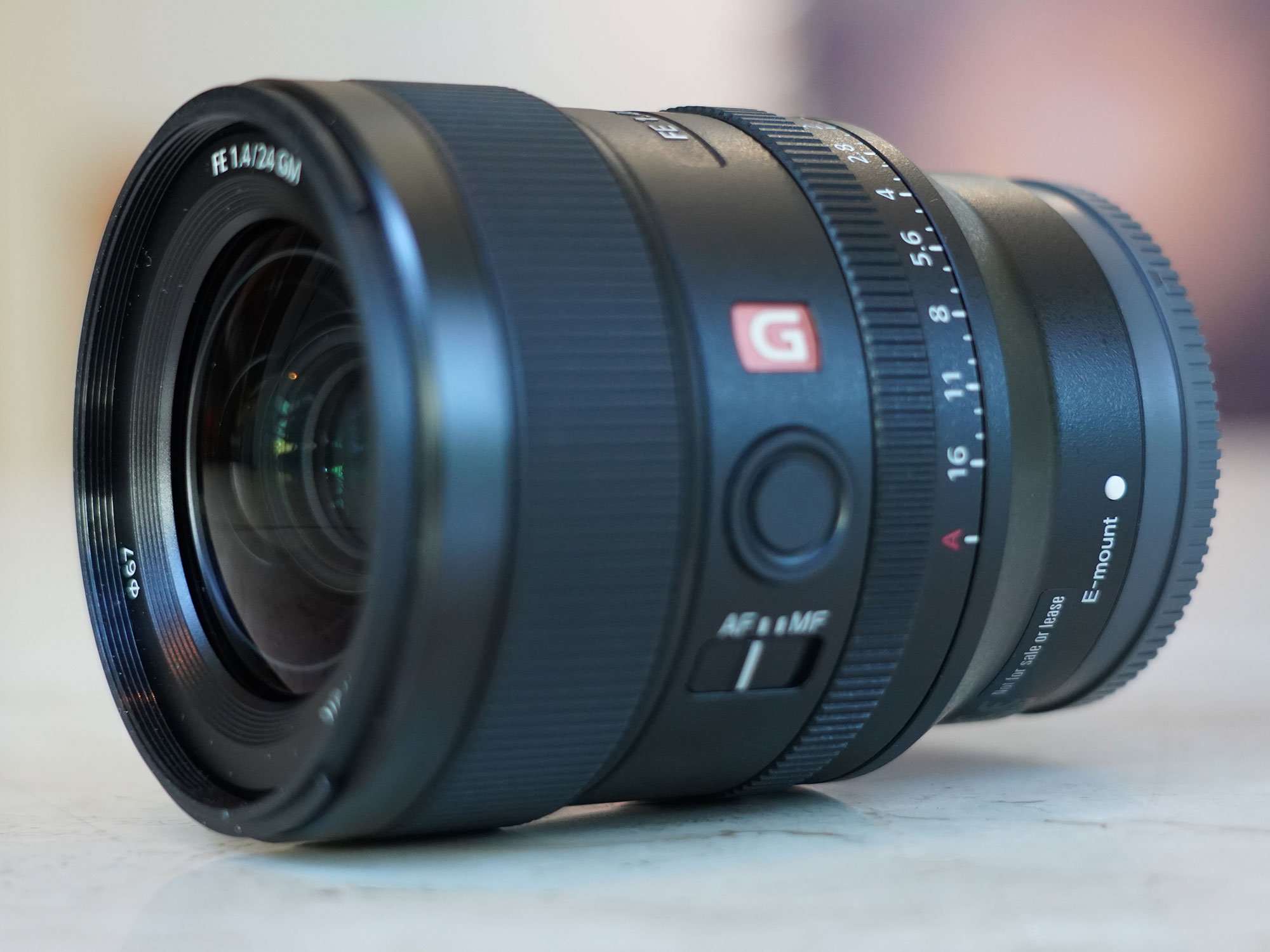
The Sony FE 24mm f1.4 G Master (also known as the SEL24F14GM) is a camera lens efflorescence lens designed for its Alpha series of full-frame mirrorless cameras. Announced in September 2018, information technology's the 30th full-skeleton mirrorless lens for Sony's Alpha system, and the 8th to junction its agio G Professional series, let alone being the fourth G Master prime lens after the FE 85mm f1.4, FE 100mm f2.8 STF and FE 400mm f2.8.
The Iron 24mm f1.4 GM delivers a popular subject-of-view that's wider than 28mm without the distortion related to wider options. The lens combines this coverage with a bright f1.4 focal ratio that's ideal for low-lighting-up use and can also deliver shelvy depth-of-field effects, especially when the capable is positioned around the minimum focal point distance of 24cm. Comparable each G Overcome lenses, the FE 24mm f1.4 GM aims to deliver both high resolution across the frame also as pleasing rendering of blurred areas. Its de-clickable aperture ring also makes IT slap-up for TV work.
To hear how the Sony FE 24mm f1.4 GM performs I tested information technology against the Zeiss 25mm f2.0 Batis on the 42MP A7R Cardinal torso and compare it also to the Sigma 24mm f1.4 Art and the Zeiss 28mm f1.4 Otus. So if you'rhenium interested in which wide-lean on prime to choose, you've come to the right place!
Facts from the catalog
As accustomed I'll have a appear at the method data of the Sony FE 24mm f1.4 GM first. I've rated the features with a [+] (surgery [++]), when it's better than fair or even state of the art, a [0] if it's standard operating theatre just average, and [-] if there's a disadvantage. For comparability I use the Sigma 24mm f1.4 Art and the Zeiss 25mm f2.0 Batis ("Sigma Art" resp. "Zeiss Batis" for short).
Size (diameter x length): 75 x 92mm (3.0 x 3.6in.) plus 31mm for the lens hood which is 95mm in diameter. The Sigma Art is much bigger at 85 x 119mm (without lens hood) as it was designed for DSLRs and has to bridge the difference in flange aloofness. The Zeiss Batis is 81 x 73mm + 36mm for the lens hood (92mm diameter). [+]
Weight: 445g (15.7 oz.) addition 33g for the lens hood. The Sigma Art is much heavier at 760g (26.8 oz., without lens system exhaust hood). The Zeiss Batis is the lightest at 335g (11.8 oz.) plus 25g for the lens hood. But then it has a nonpareil stop slower focal ratio. [+]
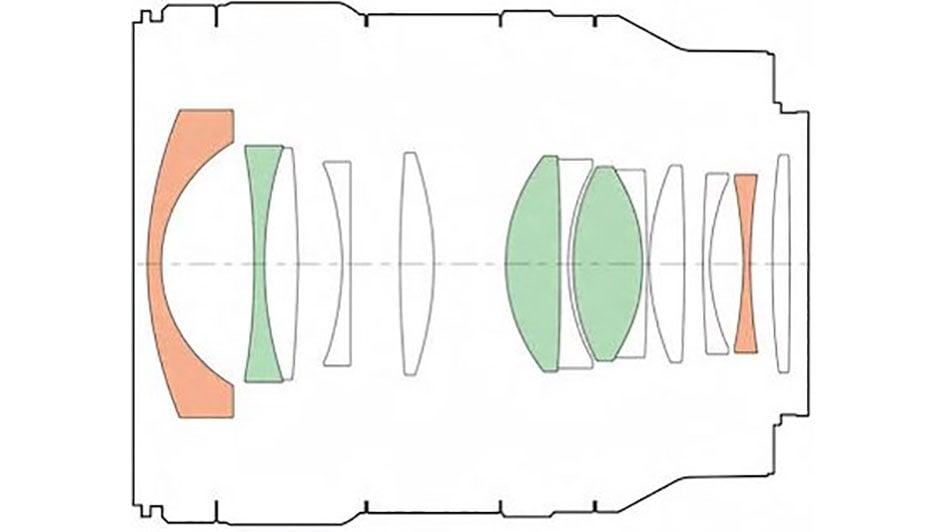
Optics: 13 elements (including 3 special dispersion elements and 2 aspheric elements) in 10 groups. There's fluorine coating on the front to repel water, dust, and grunge and should wreak easier cleanup plus the lens uses Nano finishing to reduce flare, limelight and ghosting. The Sigma Art has 15 elements in 11 groups, the Zeiss Batis has only 10 elements in 8 groups. [+]
Closest focus distance is 0.23m (9.1in.) in manual focus with a magnification of 1:5.4. A enlargement of 1:10 is achieved at 0.34m aloofness. The Sigma Artwork and the Zeiss Batis both achieve similar magnifications of 1:5.3 and 1:4.8 respectively. [0]
Filter-thread: 67mm, same as with the Zeiss Batis. The Sigma Art takes 77mm filters. [+]
Image stabilization: No optical stabilization of the lens. The Sony A7 bodies provide built-in sensor-shift stabilization. Same with the Sigma Art and the Zeiss Genus Batis. [0]
Car focus: Shapely-in AF drive. Manual of arms-focus override is by simply turning the focus ring. The focus ring has a lineal gearing that allows for precise manual of arms pore and makes smooth focalise pull for videographers easy merely offers no length markings. There's a customizable focus-shut away button on the barrel that the competitor does not offer. The Zeiss Batis offers a display for focus distance and depth of field and its gearing is not-linear: this allows for straight more correct manual concentrate when turned slowly but makes smooth focus pulling for videographers nearly hopeless. Cente the Sigma Art works differently as it has a direct running mechanical conjugation between the focus ring and the focus action. It also offers the outdistance and dof markings that normally come with lenses designed for DSLRs. [+]
Covers full frame/FX or small. Same with the competition. [+]
Price: The lens presently sells for 1600 EUR (incl. 19% VAT) / 1400 USD. The Sigma Art goes for such less: 730 EUR / 850 USD. The Zeiss Batis lies in the middle at 1130 EUR / 1200 USD. [-]
The Sony GM electron lens comes with a padded pouch including a strap and the lens hood is enclosed. It is reversible for enrapture and has a lockup mechanism to preclude it from unintentionally falling off. The Sigma Prowess has a padded pouch too merely no whip and the lens bonnet has no lock. The Zeiss Genus Batis comes without a pocket. [+]

Aperture ring: yes, with 1/3 terminate clicks. Set the annulus to "A" and the aperture is controlled away the camera or turn IT to set the aperture from the knell. On that point is none lock u to prevent the ring from being accidentally moved from the "A" position but the electron lens has a change to turn the clicks off so that the aperture terminate be operated incessantly, smoothly, and noise-free. Neither the Sigma Art nor the Zeiss Batis have an aperture ring. [+]
Waterproofing: yes, a rubber cringle at the lens-jump on plus far special weather-sealing throughout the construction, just like the Sigma Art and the Zeiss Batis. [+]
The score in the "features-department" is 1[-]/2[0]/9[+], the well-nig characteristic features of the lense beingness the Diamond State-clickable aperture telephone, the lockable lens hood and the focus lock clitoris. Plus it is pretty pack together for an f1.4 lens and well shielded against the elements. Its lone drawback is the high price.
Three wide-angle prime lenses

Above from left to right: Zeiss 25mm f2.0 Batis, Sony FE 24mm f1.4 GM, Zeiss 28mm f1.4 Otus (needs E-bestrid adapter)
Alternatives
If you want a 24mm lens with E-mount, autofocus, and an f1.4 focal ratio there is just one mutually exclusive:
- Sigma offers the AF 24mm 1.4 DG HSM Art (730 EUR / 850 USD). IT's an optical design from 2015 for DSLRs which is available in E-mount since 2018. Ensure my Sigma 24mm f1.4 Art brush up where it earned a Highly Recommended.
If you consider slower, manual focus lenses, or altered lenses there are other alternatives, e. g.:
- Zeiss has the 25mm f2.0 Batis from 2015 for 1130 EUR / 1200 USD. Its unrivalled stop slower focal ratio is the biggest disfavour over f1.4 primes. The 1mm thirster focal distance should not form a big divergence. See my Zeiss 25mm f2.0 Batis review where it earned a Extremely Recommended.
- Zeiss also offers the 28mm f1.4 Otus from 2014 which is manual focus only and can constitute used on an EF to E-Hop on adapter. The genus Lens is super big and heavy (1.3kg) and sells for a thumping 4500 EUR / 5000 USD. But its optical performance is top of the inning nick. See my Zeiss 28mm f1.4 Otus review where it attained a Extremely Recommended.
- Samyang/Rokinon/Walimex has a 24mm f1.4 Male erecticle dysfunction AS UMC lens for Sony E-Mount from 2013 but lonesome for manual concentrate which costs around 540 EUR / 500 USD.

Focus
Focus truth and repeatability is critical to consistently green goods file-like shots especially with large aperture lenses. Repeatability (the accuracy of focus on the unchanged national after repeated focus-acquisition) of this lens is same cracking (measured 98.8% in Reikan FoCal) with no outliers over a series of 40 shots. There is only a precise slight focus mutation whether the lens focuses from a closer distance Oregon from infinity.
The lens focuses in approximately 0.5 sec on an A7R II from eternity to 0.34m (1:10 magnification), which is in no time. The Sigma Art was a little slower at 0.6 sec but that was measured on a Nikon D810. The focus ring is 13mm wide-screen. It moves very liquid and can easily be operated with one finger.
AF-operation of the electron lens is inaudible from the outside and if you record telecasting with the built-in microphone the AF-drive produces no sound. Equally you pull focus, you'll notice some focus sweet-breathed: the image becomes 6% Thomas More magnified when I adjusted the focus from infinity to 0.34m. This could be distracting when shooting videos.
Next check into my quality results!
Check prices on the Sony FE 24mm f1.4 GM at B&H, Adorama, or Wex. Alternatively get yourself a re-create of my Privately book or treat me to a coffee! Thanks!Pages: 1 2 3 4
Sony FE 24mm f1.4 GM review
Source: https://www.cameralabs.com/sony-fe-24mm-f1-4-gm-review/


Posting Komentar untuk "Sony FE 24mm f1.4 GM review"